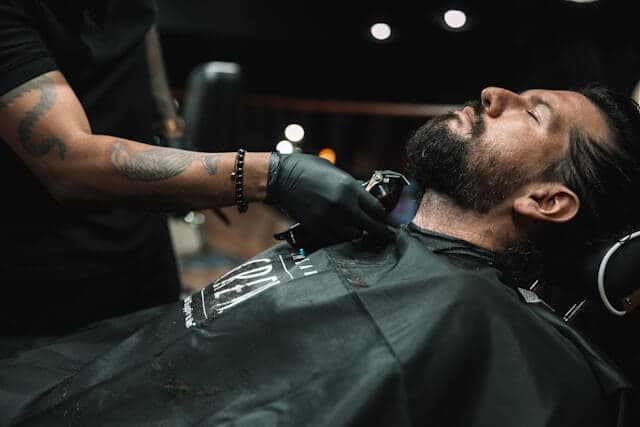
A barbershop's revenue is a rhythm. Every client is on a cycle — three weeks, four, six — and the whole business is the sum of those cycles. The two ways to grow without adding chairs are shortening the cycle, and making sure nobody quietly drifts to the shop across town.
A loyalty card that lives in the client's wallet works on both levers at once: the stamps give a reason to come back to your chair, and because every visit is scanned, you finally get to see the rhythm — and catch it when it stretches.
The cycle is the business
Do the arithmetic on one client: a fade every four weeks is 13 visits a year; the same client drifting to every six weeks is about 9. Same person, same chair — roughly a third less revenue. Multiply that across a book of a few hundred clients and cycle length is worth more than any single new-client promotion. (Estimates, obviously — your prices and your book are the real math.)
Paper punch cards were made for this — buy 5 cuts, get the 6th free — but paper can't tell you whose cycle is stretching. A card that's scanned can.
How the card works in the shop
One QR at the mirror or the till. Clients scan it once and the card lands in Apple Wallet or Google Wallet. No app to install.
One scan per visit. The barber scans the pass when the client pays — two seconds between chairs.
Your reward, your rules. Five cuts then a free one, a discount on the sixth, a free beard trim — whatever fits your menu.
What the scans tell you
Average weeks between visits — per client, and across the whole book. This is the number to shorten.
Overdue regulars. The four-week client sitting at week seven is the most valuable message you can send today.
Slow-day patterns. Who actually comes in on Tuesdays — and who could be nudged there.
New vs returning. Whether that Instagram push brought one-off cuts or actual regulars.
Kardly's numbers are visit-based — scans, members, cycles. No POS hookup, and no pretend revenue dashboards: where money appears in this guide, it's an estimate you can redo with your own prices.
Six mechanics that fit a barbershop
The classic. Five stamps, sixth cut free — or discounted, if a free cut is too heavy for your margins.
Midweek double. Double stamps on Tuesday and Wednesday point regulars at the chairs that sit empty.
Bring-a-friend. A stamp when a member's referral gets their first cut — the strongest acquisition channel a shop has, made countable.
Early-rebook bonus. An extra stamp if the next visit lands within four weeks — the cycle-shortener, made explicit.
Product stamp. A stamp on beard-oil or pomade purchases, if retail matters to you.
Win-back. When a regular hits double their usual gap, a personal message with a small incentive. Most will have simply drifted — a nudge is usually all it takes.
Set it up between two clients
Design the card. Logo, colors, stamp count, reward. Ten minutes, self-serve.
Put the QR at the till and the mirror. Where clients wait is where they scan.
Scan at payment. From any phone — every barber can do it.
Check the dashboard weekly. Especially the overdue list — that's where the money hides.
Measure it honestly
Watch three numbers over a quarter: members joined, the average gap between visits, and the share of your book that's overdue. Redemptions matter too — a claimed free cut is proof the loop closes.
If the average gap across your book shortens by even a few days over a quarter, the program has likely paid for itself several times over — an estimate you can verify with two numbers from your own dashboard, not a promise.
Frequently asked questions
Do clients need to install an app?
No. The card is added to Apple Wallet or Google Wallet from a QR code — wallets their phones already have.
I already rebook clients at the till — why a card?
Rebooking works until the client wants flexibility. The card doesn't replace rebooking — it catches everyone who didn't rebook, keeps score visibly in their wallet, and flags the ones who slipped through.
Does it work for a shop with several barbers?
Yes — any barber can scan from their own phone, and the dashboard shows the whole book, not one chair.
What does it cost to start?
You can design the card and go live the same day, self-serve — no demo call. Current plans are on the pricing page.
Your book already has a rhythm. Put the card in your clients' wallets and you'll finally see it — and shorten it.